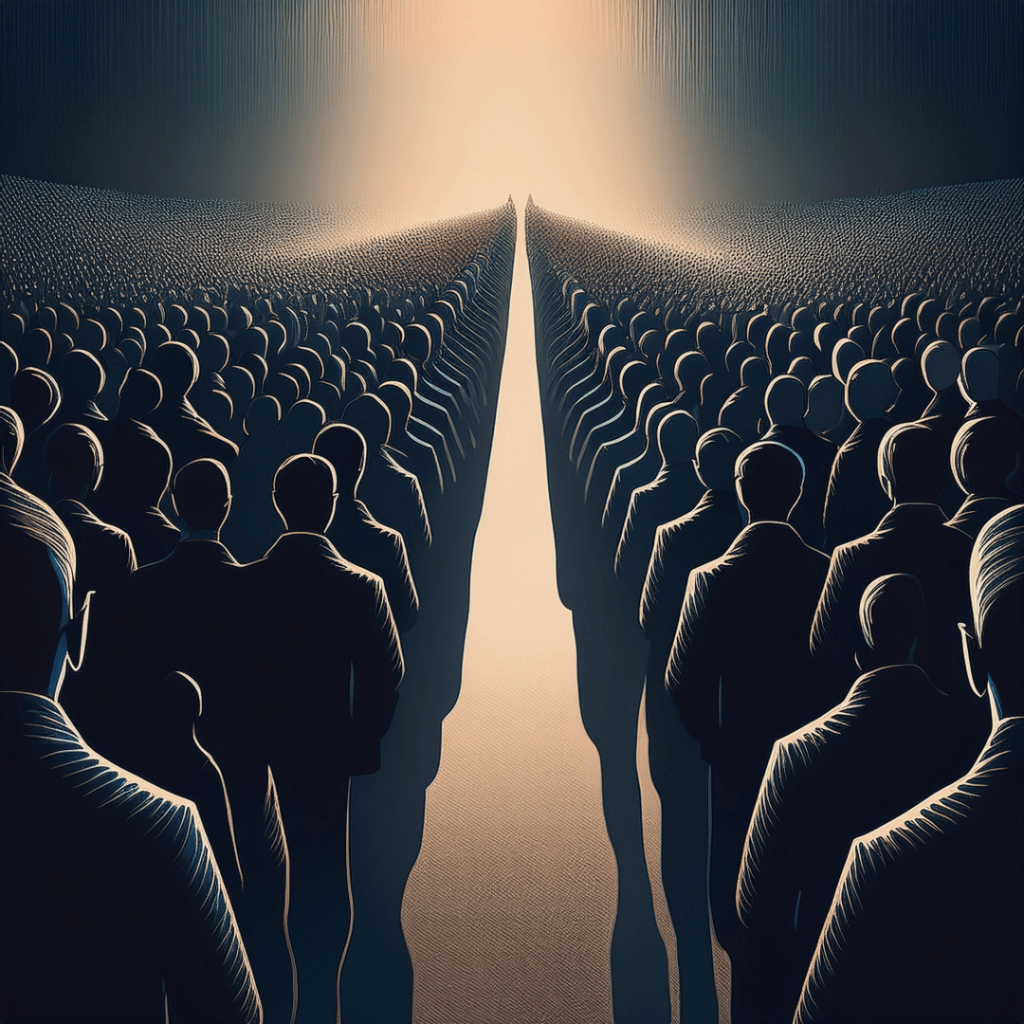
Thomas Carlyle claimed that democracy was the despair of not finding heroes to lead us. There was a strong conviction that societies, in moments of crisis or uncertainty, look for heroic figures who embody grandeur, moral strength, and the capacity to bring order out of chaos. Carlyle lauded the Middle Ages for preserving the memory of noble heroes and upheld the notion that such figures were necessary for the moral fortification of any civilization. In one of his later lectures, Carlyle argued that history is primarily driven by the actions of “great men.” He even suggested that in previous eras, the identification of these great men was self-evident; in the Middle Ages, knights and monarchs were upheld as paragons of virtue and honor. Carlyle believed that medieval societies were morally stable because they venerated figures who could embody an ideal of service, bravery, and piety. The knights of old, by their legendary deeds, fed the collective imagination with examples of chivalry and courage.
His veneration of the past was a direct reflection of how Carlyle felt about his own time. He believed democracy’s reliance on majority rule and leveling impulses undercut the special status of truly gifted and heroic individuals. The gradual erosion of strict class hierarchies and the rise of more egalitarian sentiments could, in his view, create a crisis in which societies would struggle to identify and anoint their heroes. In so doing, societies risked drifting aimlessly, lacking the guiding moral exemplars who could propel them forward. The “despair” that Carlyle spoke of was the condition of rudderlessness where heroic qualities were neither recognized nor cultivated on a broad scale.
Recently, there has been a call for a return to masculinity in an assumed form. That is—much like the “What is a Woman?” question that spawned on the right—the answer to what masculinity is on the political right is held to be common sense or simply and circularly “what men should do”. Senator Josh Hawley—whose gazelle-like run through Congress on January 6th should have been the cover art for his book “Manhood”—said that liberals were trying to attack traditional manhood by redefining it as toxic. Zuckerberg said that society had become neutered and emasculated. Christine Emba in a Washington Post opinion article argued that models of masculinity have faded and new ones haven’t quite crystallized, implying perhaps that young men are looking to right-wing social media personalities and podcasters to fill the void. Coleman Hughes attributes the feminization of culture to the attraction of many young men to misogynist Andrew Tate.
For these right-wing figures, Donald Trump—of all people—has emerged as the masculine hero. It is more accurate to say that Trump is hero to many older men, while he is hero-by-proxy to many younger men given the lionization of Trump by their role models.
Trump fits the hero model in few ways. He is out of shape. His rhetoric is poor. He has done nothing heroic. Hundreds—with mixed success—have publicly tried to explain Trump’s charismatic appeal to his MAGA followers. Carlyle’s statement on how democracies strip us of heroes always comes to mind because it pits heroism—in the way Carlyle is describing—against democracy; in doing so, it aligns heroism with authoritarianism. The ancient mythological pantheons had authoritarian leaders. Zeus was in charge of Mount Olympus. In the Middle Ages, in addition to the monarchs, the knights held tremendous authoritarian power and regularly abused it.
Chivalric literature, including the Arthurian legends and the Knightly epics, were intended to showcase the knight as a heroic figure of virtue, bravery, and unwavering honor. They were framed in history, but they were not historically accurate. They were ideological tools that helped justify the feudal order. Knights were often engaged in brutal warfare and wanton behavior including rape and pillaging. Yet, the chivalric narrative depicted them as protectors of the weak and defenders of honor—paragons of nobility and piety.
Carlyle’s idea that democracy falters when it fails to recognize and elevate exemplary figures reflects the motivations of young American men who turned to Trump. There is a sense that traditional politics and its consensus-driven norms do not provide a figure who can embody both the frustrations and hopes of young men like them. An alternative emerges: the “heroic” leader who tramples typical boundaries and does what he wants and does what he says—they claim unironically. The underlying mechanism is the same. It involves a desire for moral clarity and strong leadership at a time of pervasive uncertainty. Even if such uncertainty is a product of misinformation or fueled by major news media being funneled into an entertainment-based model, regardless, there was a clear longing for the type of hero Carlyle describes.
For these men, the perceived heroism comes from a refusal to capitulate to cultural pressures, the bravado in public discourse, and the promise to restore an idealized past in which strength and forthrightness reigned. Many young men enjoy the authoritarian appeal as a manifestation of the yearning for a simpler heroic script. Much like the medieval peasant who looked upon the knight’s banner and believed in the epic tales of chivalry, they see in Trump a restored idea of manhood and authority, unburdened by the demands of ideological complexity. They are, to an extent, consuming modern propaganda that presents the leader as someone who can do no wrong. Righteous heroism suppresses reasonable critique, just as medieval chivalric literature denied or glossed over the wanton actions of actual knights.
The fictitious quality remains evident. The narratives of medieval chivalry were, in large part, creations of poets and chroniclers who had vested interests in glorifying the aristocracy. The willingness to deny facts, science, and obvious truths is both a cause and product of the hero worship for Trump. Carlyle may give us the grounds for understanding the appeal of Trump among young men. It is one thing to remain supportive of a candidate that one voted for, but it is quite another to persist in parroting every narrative generated to explain ostensible harmful and—at times—horrific acts, such as renditioning people to a Salvadorian slave prison without due process.
The chivalric texts were not devoid of any mention of wrongdoing by knights. But they consistently claimed that knights were bound by an honor code and that their peccadillos must be forgiven. They eschewed the atrocities committed by the knights and venerated them as heroes with justified authoritarian power.
From Carlyle’s perspective, a modern crisis of democracy remains unresolved: democracy, absent a moral or spiritual core, would find it difficult to produce truly noble leaders. It risks gravitating towards figures who utilize populist energy, simplistic slogans, and forceful personalities. An authoritarian figure can fill the vacuum left by democratic processes that seem neither dynamic nor inspiring. Everyone who participates in the sociopolitical sphere in the U.S.—even if just in conversations with family and peers, or in informal online communities, or within townhalls—should consider whether they want to tell chivalric tales or push for accurate narratives that don’t whitewash what is going on right now.
 Epistemica
Leave a comment