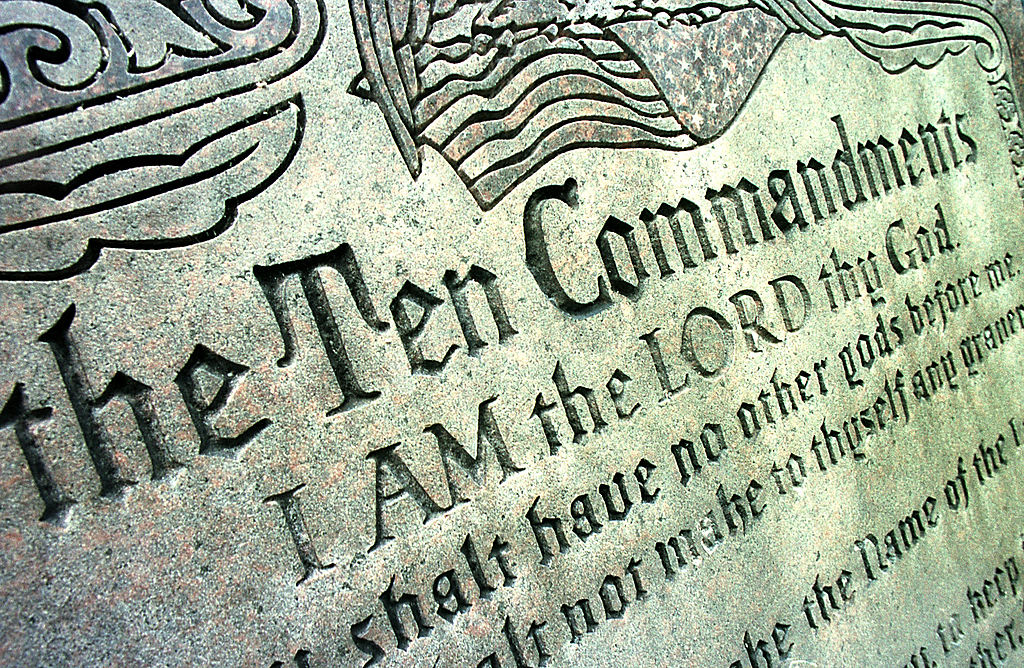
Texas’s requirement that the Ten Commandments be installed in public school classrooms is, as a matter of First Amendment principle, an obvious violation of the separation of church and state. The state is compelling a state-selected religious text to occupy classroom walls. In its efforts to de-secularize schools, the GOP’s goal of moral and religious indoctrination may backfire.
Texas Senate Bill 10 requires a durable poster or framed copy of the Ten Commandments in a conspicuous classroom location, at least 16 inches by 20 inches, with text legible from anywhere in the room. The mandated text begins, “I AM the LORD thy God” and “Thou shalt have no other gods before me,” which makes the claim that this is merely a historical display hard to take seriously. Texas Attorney General Ken Paxton defended the mandate by saying the commandments are tied to America’s “legal, moral, and historical heritage” and ordered districts not blocked by litigation to comply.
It is an effort of indoctrination by repetition through authority. The state places the message where children cannot avoid it. Thomas Jefferson warned against exactly this fusion of civil power and religious conscience. In his 1802 letter to the Danbury Baptists, he wrote that religion is “a matter which lies solely between Man & his God” and that the First Amendment built “a wall of separation between Church & State.” Jefferson was arguing that government should not appoint itself religion’s landlord.
The GOP seems to have forgotten that the culture of rebellion in schools is not dead. American schools have repeatedly produced students, parents, and teachers who resist forced rituals, forced silences, and forced curricula. In West Virginia State Board of Education v. Barnette, Jehovah’s Witness students resisted compulsory flag-salute rules; the Supreme Court rejected the coercion, warning that “no official, high or petty, can prescribe what shall be orthodox in politics, nationalism, religion, or other matters of opinion.”
A compelled salute created dissent. Likewise, school prayer cases did not end because students stopped praying, but because families challenged the state’s authority to script devotion. In Engel v. Vitale, the Court held that the state could not hold prayers in public schools, even if supposedly voluntary. In Abington v. Schempp, it held that schools could not require Bible readings or the Lord’s Prayer at the start of each day.
In Des Moines, students wore black armbands to protest the Vietnam War despite being warned they would be suspended; their defiance became Tinker v. Des Moines, the landmark student-speech case. In 1968, thousands of Chicano students in East Los Angeles walked out to protest overcrowding, corporal punishment, run-down campuses, racist treatment, and lack of culturally relevant courses. In 2015, more than 200,000 New York students refused state-mandated Common Core tests. In Tucson, after Mexican American Studies was canceled, students skipped school and organized teach-ins to learn what the district had taken away.
This is the lesson Texas Republicans seem to have missed. Student culture tends to be anti-culture, a resistance against zealous authority and adult hypocrisy. A poster meant to impose reverence may instead become a daily invitation to interrogate power. Why this version of the commandments? Why not the Beatitudes? Why not the Quran, the Bhagavad Gita, the Buddhist precepts, the Satanic Temple’s tenets, or the Bill of Rights? Why is “Thou shalt not kill” on the wall while lawmakers dodge the question of guns in schools?
Foucault said, “Where there is power, there is resistance.” Power never simply lands on people. It tends to be an unintended catalyst for counter-moves. A classroom mandate can create lawsuits, counter-posters, memes, walkouts, silent refusals, comparative-religion clubs, and students newly curious about the Establishment Clause. The more the state insists the display is harmless, the more obvious its purpose becomes.
The backfire may also be religious as many believers do not want scripture reduced to state décor. Forced piety has a way of cheapening faith, particularly in that it teaches students that Christianity is a partisan emblem, something politicians nail to a wall after cutting mental-health services, censoring books, or ignoring poverty. It is branding than evangelism.
If Texas wanted students to discuss the Ten Commandments in a serious class on religion, law, or ethics, that would be education. Students could compare Jewish, Catholic, Protestant, and secular interpretations. They could ask which commandments map onto civil law and which do not. They could debate whether moral conduct comes from fear, empathy, reason, revelation, or community. But none of this can be achieved with a compulsory poster.
The Texas mandate risks creating exactly the kind of skepticism its supporters fear. The GOP imagines the classroom as a stage for obedience but American school history suggests that coercion becomes dissent. The state may post commandments; students may learn constitutional law. The state may demand reverence; students may discover irony. The state may try to Christianize the classroom; it may instead secularize a generation’s view of political religion.
Republicans veil indoctrination behind panic over school safety and alleged moral depravity, but moral posters are not plans of action to prevent gun violence in schools. In the 2013 Arapahoe High School shooting, Karl Pierson killed one student and himself; a profile cited by school-shooting researcher Peter Langman described him as coming from “a religious family that attends Bible study meetings.” The idea that more God in school will prevent mass shootings is laughable. The U.S. is highly religious compared to most European countries, all of which have much lower rates of gun violence and school shootings.
Until the GOP can explain how “Thou shalt not kill” stops a bullet, Texas’s new classroom décor may simply teach students that thou shalt question the adults who put this here.
 Epistemica
Leave a comment