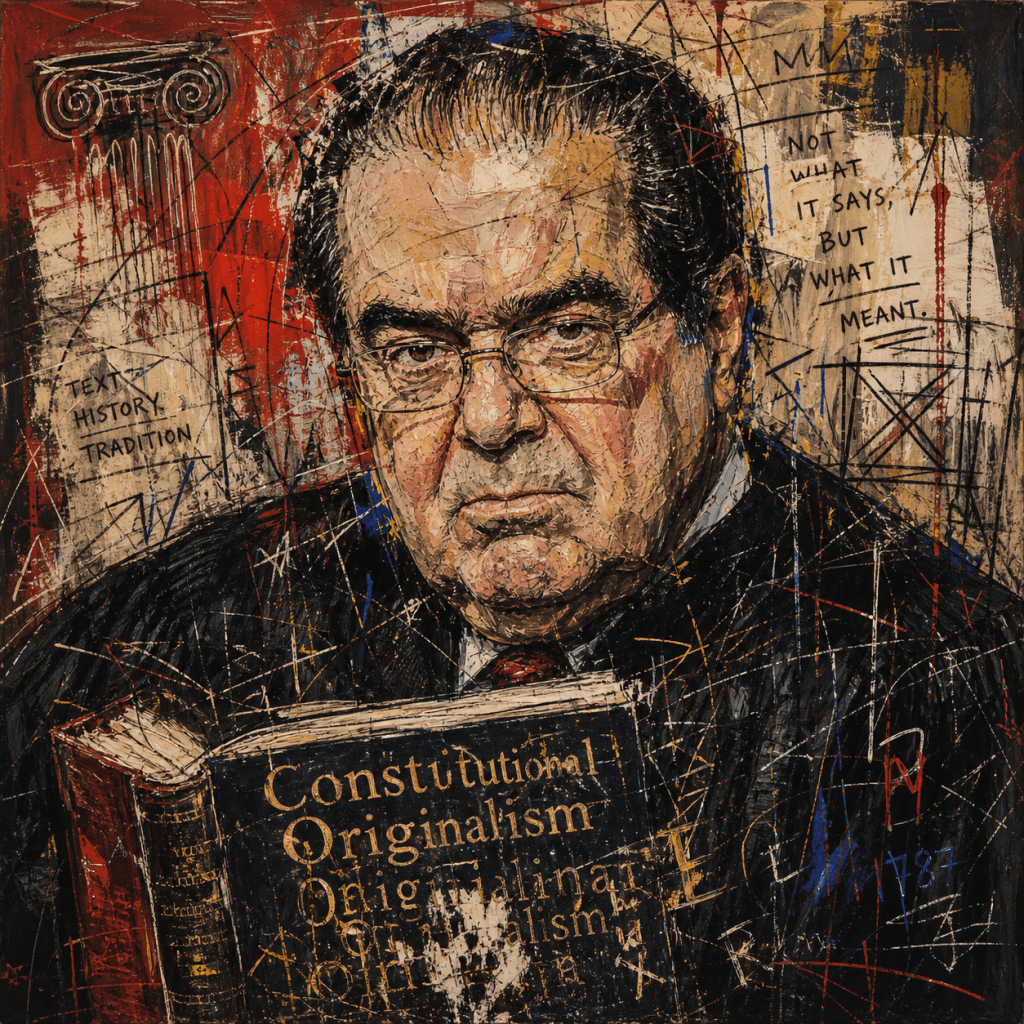
Antonin Scalia sold himself as the judge who would not invent rights, would not moralize from the bench, would not bend law to sentiment, and would not let the Constitution become whatever five justices thought it should become. In famous defense of originalism, Scalia said the Constitution was “an enactment that has a fixed meaning,” one “ascertainable through the usual devices” of legal interpretation; he warned that the great danger of nonoriginalism was that judges would “mistake their own predilections for the law.” Originalism, he argued, supplied a “historical criterion” that could stand apart from the judge’s personal preferences.
If he so adamantly defended originalism, and so often publicly espoused breaking from the Founders’ intentions, why did his opinions and dissents so often betray these ideals? So often, the rule he announced in one case softened, disappeared, or reversed itself in another, so much so that a book containing only his judgements could be viewed as a living, breathing jurisprudence rather than a static, originalist framework. For Scalia, judicial restraint was sacred until judicial intervention became useful. Federalism was sacrosanct until federal power served a favored punitive regime. Equal protection was too narrow to protect gay people from structural political exclusion, but broad enough to halt a presidential recount. Democratic self-government was revered when majorities enforced sexual conservatism, but suddenly secondary when the Court could deliver outcomes Scalia liked. All of these contradictions comprise the Scalia method of jurisprudence.
In the same essay in which Scalia condemned judges for personalizing the Constitution, he admitted that originalism might be “medicine that seems too strong to swallow.” He used flogging and hand-branding as examples of punishments that may not have been unconstitutional at the founding, then confessed: “I hasten to confess that in a crunch I may prove a faint-hearted originalist”; he “cannot imagine” himself upholding a law imposing flogging.
Scalia’s critique of living constitutionalism was that it allowed judges to smuggle moral revulsion into constitutional law. But his own “faint-hearted” exception did exactly that. If original meaning controls, then the judge’s inability to “imagine” upholding a punishment is irrelevant. If the judge’s moral horror matters, then the historical criterion is not the rule but a mere presumption overridden by temperament. Scalia saw the problem himself in that if evolving standards are allowed for the Eighth Amendment, he asked, why not due process and equal protection too? At that point, he conceded, there may be “no difference between the faint-hearted originalist and the moderate nonoriginalist.”
Yet in Roper v. Simmons, when the Court barred the juvenile death penalty, Scalia’s dissent denounced precisely the kind of moral judgment he had reserved for himself. He accused the Court of making itself “sole arbiter of our Nation’s moral standards” and objected that the Eighth Amendment should not be determined by “the subjective views of five Members of this Court and like-minded foreigners.” Scalia’s own theory made room for his subjective horror at flogging, while his dissent treated the majority’s moral judgment about executing juveniles as illegitimate judicial will.
Consider Bush v. Gore. In his concurrence to the stay that stopped Florida’s recount, Scalia wrote that counting votes of “questionable legality” threatened “irreparable harm to petitioner, and to the country,” because it would cast “a cloud” on George W. Bush’s claimed election legitimacy. The Court’s eventual per curiam opinion, which Scalia joined, held that varying recount standards violated equal protection, while also insisting that its “consideration is limited to the present circumstances.” It was a constitutional rule announced for one case, one election, one winner, and then was quarantined.
Compare that with Scalia’s plurality in Vieth v. Jubelirer, where he rejected federal adjudication of partisan gerrymandering claims. There he insisted that courts must act “by standard, by rule,” and that “law pronounced by the courts must be principled, rational, and based upon reasoned distinctions.” He dismissed proposed political-gerrymandering standards as casting judges “forth upon a sea of imponderables” and said “fairness” was not a judicially manageable criterion.
In Bush, the Court intervened in an election under an equal-protection theory so improvised that the opinion itself warned readers not to generalize it. In Vieth, Scalia refused to intervene in election manipulation because the standards were not sufficiently “principled” or “manageable.” In one case, unequal electoral treatment demanded emergency judicial power but in the other, electoral distortion was beyond courts. .
Scalia’s federalism shows the same looseness. In United States v. Morrison, Scalia joined the majority striking down part of the Violence Against Women Act. The opinion warned that Congress could not regulate noneconomic violent crime merely by aggregating its effects on interstate commerce, because such reasoning would blur the distinction between “what is truly national and what is truly local.” The suppression of violent crime, the Court said, was a classic state police-power function. In Printz v. United States, Scalia wrote for the Court that the federal government could not compel state and local officers to administer federal handgun-background-check duties, concluding that the federal government may not force states to “enact or administer a federal regulatory program.”
But in Gonzales v. Raich, Scalia’s federalism became suddenly capacious. California had permitted medical marijuana use, and the plaintiffs challenged federal application of the Controlled Substances Act to local cultivation and possession for personal medical use. Scalia concurred in upholding federal power. Scalia wrote that Congress may regulate intrastate activities that do not themselves substantially affect interstate commerce when doing so is necessary to a broader regulatory scheme, and even said Congress may regulate “noneconomic local activity” if it is a necessary part of a more general interstate-commerce regulation.
There is a doctrinal distinction between commandeering state officers, as in Printz, and preempting private conduct, as in Raich. But the broader rhetoric is impossible to reconcile via jurisprudence. In Morrison, aggregate-effects reasoning threatened to create a national police power. In Raich, aggregate-effects reasoning was fine because homegrown medical marijuana might undercut a national drug scheme. Scalia even said the noneconomic character of simple possession was “immaterial.” Federalism, for Scalia, ends up not being an even-handed shield for local democratic choice because it hardened against federal civil remedies for gender-motivated violence and federal gun checks, then melted before the punitive drug war.
The equal-protection cases involving gay people reveal the moral content behind Scalia’s supposed neutrality. In Romer v. Evans, the Court struck down Colorado’s Amendment 2, which singled out gay, lesbian, and bisexual people by preventing them from obtaining ordinary antidiscrimination protections. The majority said the amendment imposed a broad disability and made one class “stranger to its laws.” Scalia dissented. He mocked the majority’s description of the case as a “Kulturkampf for a fit of spite” and called Amendment 2 a “modest attempt by seemingly tolerant Coloradans to preserve traditional sexual mores.”
How does “traditional sexual mores” possibly come into the equation here? Scalia often claimed merely to defend democracy against judicial arrogance. But here democracy was the legal preservation of a moral hierarchy. His dissent treated gay people’s exclusion from ordinary political protection as no real constitutional injury, while his Bush vote treated inconsistent standards for counting disputed ballots as an equal-protection emergency. Equal protection was elastic enough to stop a recount, but too rigid to see a statewide constitutional amendment targeting one unpopular group.
In Lawrence v. Texas, where the Court invalidated Texas’s criminal sodomy law, Scalia again framed his dissent as judicial restraint. He accused the majority of inconsistency and said precedent should be “consistent rather than manipulative.” But he also defended the law as an expression of sexual morality, writing that Texas furthered the belief that certain sexual behavior was “immoral and unacceptable,” and warning that the Court had decreed “the end of all morals legislation.” He then insisted, “I have nothing against homosexuals,” while defending the power of majorities to criminalize their intimate conduct.
This is prejudice translated into jurisdictional language. Scalia did not have to announce personal animus to reveal the structure of his judgment. He repeatedly found democratic dignity in laws that marked gay people as morally disfavored, then found judicial overreach when the Court protected them. By Obergefell v. Hodges, his dissent described marriage equality as rule by “a majority of the nine lawyers,” “constitutional revision by an unelected committee of nine,” and a “naked judicial claim to legislative—indeed, super-legislative—power.” It was the opposite of Bush v. Gore where five justices resolved a presidential election while claiming unmatched consciousness of “the vital limits on judicial authority.”
Scalia’s defenders often say these are just doctrinal differences such as equal protection here, political question there; commerce power here, commandeering there; original meaning here, stare decisis there. But any judge can preserve the appearance of consistency by carving doctrine into small enough boxes and flooding rules with exceptions. It’s obvious that Scalia’s doctrinal exceptions aligned with his prejudices.
Scalia could write with such force that the chosen rule seemed inevitable while one was reading it. But across cases, the inevitability dissolved as the contradictions became obvious. Originalism was binding until it required flogging. Judicial restraint was essential until Florida’s recount threatened Bush. Manageable standards were necessary until an election case demanded a one-use equal-protection theory. State sovereignty was fundamental until California’s medical-marijuana policy conflicted with federal prohibition. Democratic choice was holy until courts could vindicate conservative constitutional claims, and oppressive when courts protected liberties Scalia disliked.
The art of contradiction, then, was jurisprudence as selective austerity. Scalia’s rules were often real, but they were not supreme and their application was dependent on their coherence with his extrajudicial views. He condemned judges who confused their values with law but his career shows how powerfully a judge can do exactly that while calling it originalist interpretation.


Leave a comment