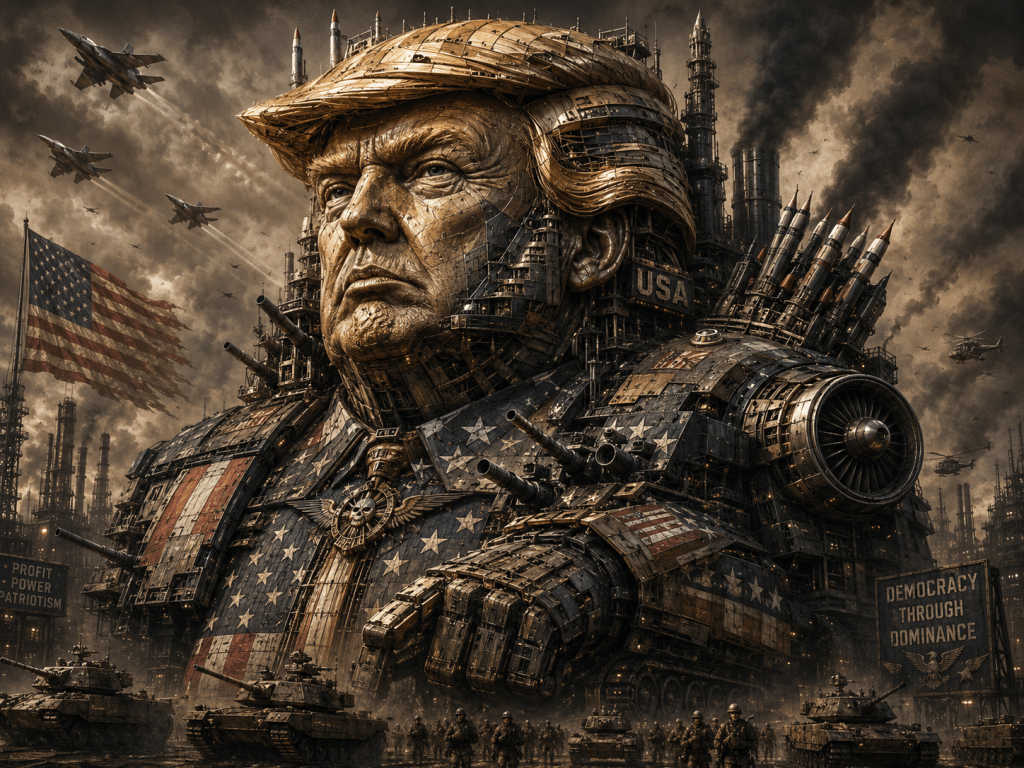
On his Truth Social account, Trump published a ledger of American war deaths. Afghanistan, Iraq, Vietnam, and Korea appeared beside the entry “Iran Military Conflict: 4 months, 18 deaths.” Compared with the bloodletting of earlier wars, of which he was actually a part of for four years (Afghanistan War), Trump suggested that the campaign against Iran had exacted a remarkably small price. There were, of course, also than 450 wounded service members, an estimated $37.5 billion in direct costs, disrupted energy markets, and no settled account of the war’s actual objective. Many of us had flashbacks of Trump boasting that COVID cases would soon be 0.
Trump’s comparative approach reflects realist (in international relations) reasoning. It also reveals where a sloganized realism becomes strategically careless. It got me thinking of the major traditions of international relations and how they were always deficient, both collectively and individually, but how they must struggle mightily in the wake of even Trump’s first term, let along his second! One of the major issues that dominated international relations when I studied it was how to define state rationality (i.e., state decision-making as an agent). Even when the individual regime, administration, or personality of the state changes, the general foreign policy ambitions tend to remain somewhat stable, allowing for the analysis of actions and intentions through various international relations lenses for a fixed period. But when foreign policy authority becomes highly personalized, a theory of state behavior that omits the leader’s psychology leaves the decisive mechanism unexplained and severely deficient.
REALISM AND RELATIVE POWER
Realism begins from an international system without a central authority capable of guaranteeing survival (i.e., the security problem). States practice self-help, watch the distribution of capabilities, and judge gains partly by their effect on rivals. Waltz made the distribution of power central to systemic explanation; Grieco and Powell later clarified why states may care about relative gains even when cooperation offers benefits to everyone. A state that becomes richer while an adversary becomes richer still may end up less secure. Conversely, a state can accept an absolute cost when the exchange weakens a dangerous opponent by more and improves its own position.
Trump’s casualty ledger can be reconstructed in this highly relativistic way, even though the comparative state is just the US at a different time period (again, ignoring the fact that the Afghanistan War has been active for 2/3rds of the time Trump has served as president). The US has lost eighteen lives, but Iran has lost military assets, personnel, some freedom of action, and possibly (it is argued) future coercive capacity. The transaction need not produce territory, reparations, or a signed capitulation, although unconditional surrender was promised by Trump. If Iran emerges materially weaker and the US retains overwhelming power, the relative shift itself acquires positive value from Trump’s warped perspective. Under realism, the enemy’s diminished ability to threaten becomes a strategic asset. In that narrow sense, relative value is treated as absolute value as the reduction of Iranian power is counted as a gain even when no direct benefit has yet appeared on the American side of the ledger, and the financial costs mount.
Jervis showed how measures taken for defense can appear offensive to an adversary, prompting countermeasures that leave both parties less secure. Washington can regard Iranian enrichment, missiles, drones, and regional networks as an intolerable future threat. Tehran can interpret attacks on those capabilities, leadership targets, and regime infrastructure as evidence that national survival is at stake. Each side then treats escalation as protection against the other’s escalation. Sacrifice is considered an insurance premium against a feared catastrophe, and this is exactly how Trump frames the issue. Eighteen deaths are presented as a limited present cost paid to eliminate a much larger prospective danger.
But realism supplies a harsher test than a low casualty count. Morgenthau called prudence—the weighing of political consequences—the supreme virtue of statecraft. Offensive realism, likewise, assumes that leaders pursue power because power protects survival; it offers no blanket endorsement of offensive war. The relevant measure is the postwar balance of security, including indirect and delayed effects. A damaged adversary can remain resilient, acquire stronger motives for retaliation, disperse sensitive programs, consolidate domestic support, or impose costs through asymmetric channels. A tactical exchange ratio does not settle such questions, and if anything it is difficult to make an argument for the US being more secure in 10 years because of the war.
The present evidence leaves the strategic balance largely unresolved. Chatham House’s Aniseh Bassiri Tabrizi concluded in July that the war’s central objectives had not materialized given that the Iranian regime survived, its missile and drone capacity endured, and Tehran’s principal red lines remained in place. Carnegie analysts similarly observed that survival itself could constitute victory for Iran, while attacks on shipping and energy infrastructure strained the global economy and depleted scarce American munitions. The moving of the goalposts from regime change and total surrender to military degradation, nuclear restraint, and control of the Strait of Hormuz also reflects the complete failure to achieve the initial goals.
The realist balance sheet is required under its theoretical framework to include more than Iranian losses and the eighteen American soldiers. It has to also count American casualties and injuries, expenditure, munitions consumed, opportunity costs in Europe and Asia, pressure on allies, oil-price effects, legal and reputational damage, and the possibility that Tehran will rebuild in a more secretive and risk-acceptant form. It must compare the war’s outcome with plausible alternatives: deterrence, containment, diplomacy, sabotage, and limited strikes. Iran can be weaker in one category and more dangerous in another. Relative power is notoriously difficult to calculate even in retrospect, making it easier to simply claim a relative power victory in the moment rather than meet one’s own stated objectives.
As mentioned above, the security dilemma provides the assumptions for realism’s reliance on relative power. A campaign organized around threat elimination can convince the target that restraint offers no safety. Once Iran believes that Washington seeks regime destruction, preserving retaliatory capacity becomes rational; compromise begins to resemble an invitation to further attack. The US may destroy launchers while strengthening the political demand for nuclear latency, hardened facilities, delegated command, and coercion at sea. In such a spiral, low American fatalities can coexist with a deteriorating long-term security environment.
Trump’s claim consequently resembles realism’s vocabulary has as it is neglecting realism’s actual commitments. It translates positional advantage into a simple scoreboard and treats enemy damage as self-validating. Serious realism asks whether the campaign produced a durable political arrangement at an acceptable total cost. Without that showing, the number eighteen is evidence of limited battlefield exposure.
FROM STATE THEORY TO LEADER THEORY
The dispute also exposes the underdetermination built into grand theories of international relations. Realism helps explain why the US worries so much about Iranian capabilities and why Iran resists American dominance. Liberal theories can identify the effects of alliances, institutions, commerce, and domestic constraints. Constructivist approaches can illuminate identities, status claims, and narratives of resistance. But none explains why one administration chose open war at this moment, why its objectives shifted, or why the president defined success through a comparison with the dead of Vietnam, Korea, Iraq, and Afghanistan.
Grand international relations theory’s failure reflects the problem that a given distribution of power can support deterrence or preventive war; the same alliance network can produce reassurance or entrapment; the same identity narrative can animate negotiation or crusade. Once a framework can accommodate each result after the fact, causal leverage migrates toward the choice architecture inside government. State-level variables do not specify why this moment produced this campaign, or why its success would be narrated through a casualty ratio.
International relations routinely relies on the fiction of the state as a person. “The United States believes,” “Iran fears,” and “Russia decides” compress bureaucracies, factions, leaders, publics, and institutions into a single actor. The simplification makes comparison seem simple, but becomes hazardous and unreliable when policy authority is concentrated and the leader’s preferences differ sharply from the equilibrium that institutions would otherwise produce. Individual foreign policy analysis has supplemented the broad lenses. Jervis demonstrated how perception and misperception shape decisions; Hermann developed methods for connecting leadership traits to policy; Saunders showed that presidents’ beliefs can influence the form and scope of military intervention. Kertzer and Tingley have argued that political psychology now cuts across the old paradigms rather than occupying a marginal niche.
This scholarship is a reimagining of the flawed Great Man Theory, Thomas Carlyle’s nineteenth-century formulation that treated universal history as, at bottom, the history of great men. Herbert Spencer supplied the enduring reply in that social conditions form the person who later appears to command them. Carlyle’s account also carried the elitism, hero worship, and gender assumptions of its era. It overlooked institutions, followers, technology, class, administration, and contingency. History simply is not the product of solitary genius.
“Great” in this context is descriptive of impact rather than normative. It describes magnitude of consequence. Modern leader-centered research supports the notion that under certain institutional conditions, a particular individual becomes a bottleneck through which structural pressures must pass. The leader chooses among materially feasible options, defines the reference point from which gains and losses are measured, selects advisers, interprets ambiguous intelligence, and supplies the language through which sacrifice becomes politically meaningful. Structure creates incentives; institutions filter them; leaders perceive and act upon what remains.
The first Trump term seemed to confirm this, but the second may suggest that it does not go far enough! The world’s most powerful state has entrusted immense coercive authority to an eighty-year-old president whose public framing of the Iran war has been volatile and intensely personal, in addition to erratic and inconsistent. His position on Iran reflects rapidly changing war aims, extreme and unsupported confidence in personal control, sensitivity to status and humiliation, and a preference for easily communicated measures of victory. Trump’s comparison of conflicts functions as a psychological document in that it reveals which costs command attention and which disappear from view. American foreign policy now is just Trump’s bloated, bombastic personality.
References
Amos Tversky and Daniel Kahneman, “The Framing of Decisions and the Psychology of Choice,” Science 211, no. 4481 (1981): 453–58; and Rose McDermott, Risk-Taking in International Politics: Prospect Theory in American Foreign Policy (Ann Arbor: University of Michigan Press, 1998).
Aniseh Bassiri Tabrizi, “The Wishful Thinking Behind the War with Iran,” Chatham House, July 21, 2026. Tabrizi argued that regime collapse, political capitulation, and decisive military degradation had not occurred, while Iran demonstrated continued missile and drone capacity and a strategy of attrition.
Eric Lob, “The Diverging U.S. and Israeli Goals in Iran Are Making the Endgame Even Murkier,” Carnegie Endowment for International Peace, March 20, 2026. Lob traced shifting U.S. objectives from regime change and unconditional surrender to military incapacitation and nuclear nonproliferation.
Hans J. Morgenthau, Politics Among Nations: The Struggle for Power and Peace, 7th ed. (New York: McGraw-Hill, 2006); and John J. Mearsheimer, The Tragedy of Great Power Politics, updated ed. (New York: W. W. Norton, 2014).
Hermann, “Assessing Leadership Style”; and Dennis M. Foster and Jonathan W. Keller, “Interactive Leader Psychology and the Ebb and Flow of Interstate Rivalry,” International Studies Quarterly 67, no. 4 (2023): sqad076.
Iran International, “Trump Compares U.S. War Deaths, Says Iran Conflict Killed 18,” July 21, 2026. The report reproduces Trump’s comparison and the entry “Iran Military Conflict: 4 months, 18 deaths.”
Jarrett Renshaw, “Trump Attends Return of U.S. Soldiers Killed in Iran War,” Reuters, July 22, 2026. Reuters reported eighteen service members killed, more than 450 injured, at least $37.5 billion in U.S. costs, higher oil prices, and differing statements of the war’s objectives.
Juliet Kaarbo, “A Foreign Policy Analysis Perspective on the Domestic Politics Turn in IR Theory,” International Studies Review 17, no. 2 (2015): 189–216; and Joshua D. Kertzer and Dustin Tingley, “Political Psychology in International Relations: Beyond the Paradigms,” Annual Review of Political Science 21 (2018): 319–39.
Kenneth N. Waltz, Theory of International Politics (Reading, MA: Addison-Wesley, 1979); Joseph M. Grieco, “Anarchy and the Limits of Cooperation: A Realist Critique of the Newest Liberal Institutionalism,” International Organization 42, no. 3 (1988): 485–507; and Robert Powell, “Absolute and Relative Gains in International Relations Theory,” American Political Science Review 85, no. 4 (1991): 1303–20.
Reuters, “Russia’s Putin Sends Birthday Greetings to ‘Bright, Remarkable’ Trump,” June 14, 2026, reporting Trump’s eightieth birthday. For the volatility of stated war objectives, see Lob, note 8, and Renshaw, note 2.
Robert Jervis, “Cooperation under the Security Dilemma,” World Politics 30, no. 2 (1978): 167–214.
Robert Jervis, Perception and Misperception in International Politics (Princeton: Princeton University Press, 1976); Margaret G. Hermann, “Assessing Leadership Style: A Trait Analysis,” in Jerrold M. Post, ed., The Psychological Assessment of Political Leaders (Ann Arbor: University of Michigan Press, 2005); and Elizabeth N. Saunders, Leaders at War: How Presidents Shape Military Interventions (Ithaca, NY: Cornell University Press, 2011).
Suzanne Maloney, Aaron David Miller, and Karim Sadjadpour, “Iran Wanted to Survive the War. Now What?” Carnegie Endowment for International Peace, June 18, 2026. Sadjadpour described regime survival as Iran’s principal metric; Maloney emphasized asymmetric economic pressure and the depletion of munitions relevant to other theaters.
Thomas Carlyle, On Heroes, Hero-Worship, and the Heroic in History (London: James Fraser, 1841), lecture I; Herbert Spencer, The Study of Sociology (London: Henry S. King, 1873); and Bert A. Spector, Discourse on Leadership: A Critical Appraisal (Cambridge: Cambridge University Press, 2016), 18–32.
 Epistemica
Leave a comment